BranchBox · Open-source engineering
Isolating the whole runtime, not just the branch.
BranchBox gives each feature its own working tree and runtime boundary so developers and coding agents can work in parallel without competing for the same application environment.
v0.11.1 · Open source · MIT
The problem
A branch can be isolated while the runtime still collides.
Parallel development gets fragile when supposedly separate work still shares ports, databases, Docker networks, environment state, or cleanup assumptions.
Git isolates source history. It does not isolate the system the code actually runs inside. As more work happens concurrently—especially with coding agents—that distinction becomes operational.
Key decision
Parallel software work needs isolated runtime state, not just separate Git branches.
BranchBox gives each feature its own working tree and runtime boundary so developers and coding agents can work in parallel without competing for the same application environment.
-
checkout-reliability Feature environment
- Working tree
- Runtime context
- Application state
-
billing-rules Feature environment
- Working tree
- Runtime context
- Application state
-
search-index Feature environment
- Working tree
- Runtime context
- Application state
See it in action
The runtime boundary shows up in the CLI.
-
Start a feature environment
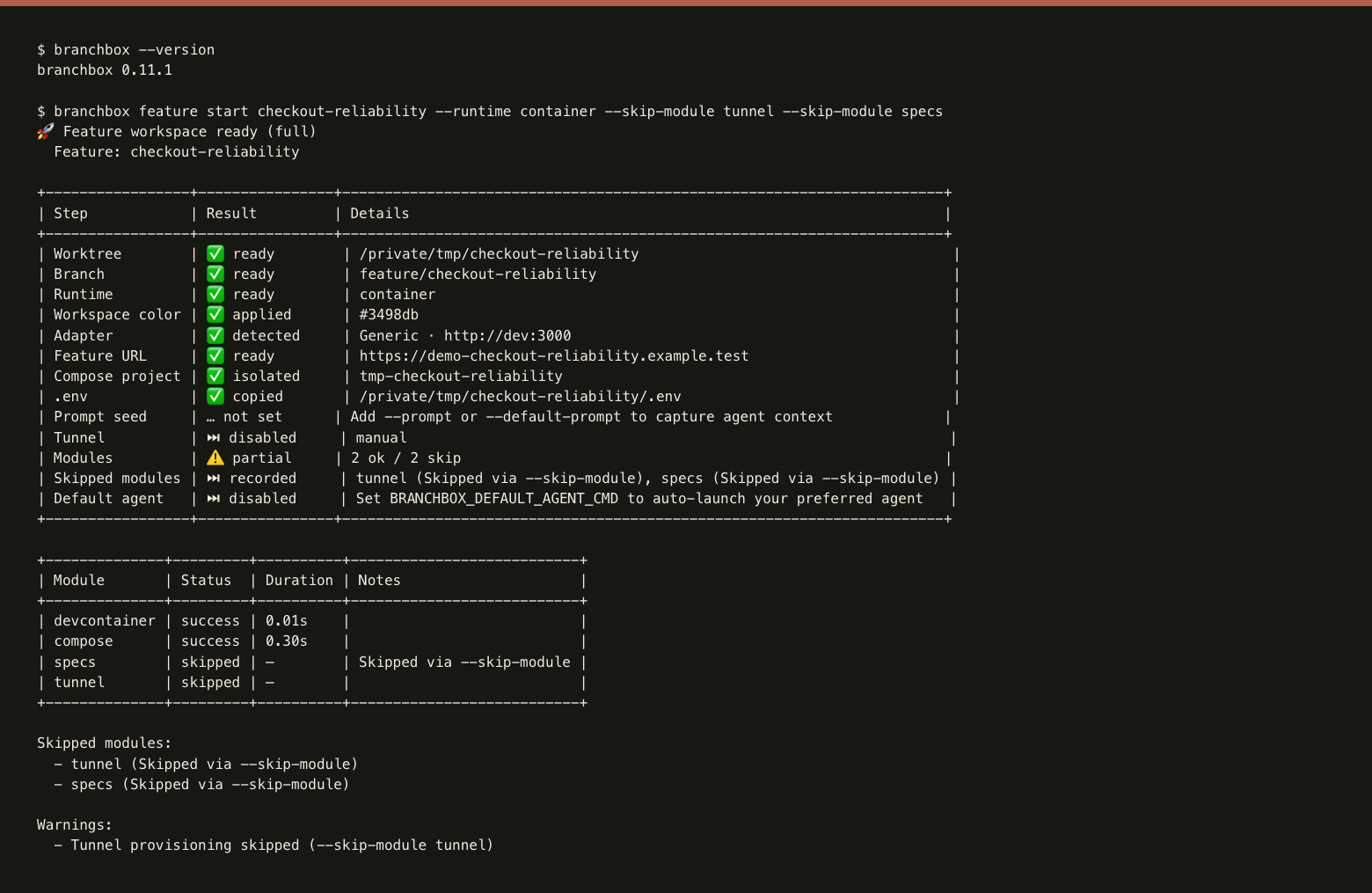
Starting a feature creates a separate worktree, feature branch, container runtime, Compose project, application URL, and copied environment for that piece of work.
-
Inspect the active environment

The feature list shows the active environment and the runtime, branch, modules, and URL that belong to it.
Architecture
The isolation boundary, made explicit.
Per feature / isolated
What BranchBox isolates
Each feature gets its own working tree and runtime context, with the application state that commonly makes parallel development collide kept separate by the selected runtime and project modules.
- Working treeFeature branch
- Runtime / provider contextContainer in this capture
- Application / container stateKept separate by the runtime
- Module-created project resourcesCompose · network · ports · database where selected modules apply
Deliberately shareable by default
What BranchBox deliberately shares
BranchBox can mount selected developer authentication and coding-agent configuration into feature environments so existing tools work without repeated setup. In the current release, branchbox init --no-coding-agents disables the .codex, .claude, and .gh mounts.
- .codexSelected auth / configuration
- .claudeSelected auth / configuration
- .ghSelected auth / configuration
Operator control
The trade-off
BranchBox isolates the workspace and runtime state that should not collide. It does not claim that every credential or configuration file is duplicated per feature. Shared authentication is an explicit ergonomics/security choice, not hidden state.
- branchbox init --no-coding-agentsDisables coding-agent mounts during initialization
- Explicit boundaryNot a retroactive guarantee for every host credential or third-party tool
Why this matters
Parallel work needs more than separate source history.
BranchBox lets parallel work move faster by separating the application environments that would otherwise interfere with each other, while making the remaining shared-tool boundary explicit and configurable.
- Developer-platform product thinking rather than one-off automation
- Runtime and application-state isolation for parallel human and AI-assisted development
- Released Rust CLI engineering integrated with conventional application infrastructure
- An explicit, configurable boundary for shared developer authentication and coding-agent configuration
- Released teardown handling for worktrees and module-created resources
- Productizing a recurring internal engineering failure mode into reusable software
Open source